Dance like nobody's watching . . . and blog like nobody's reading it.
I just read a terrific and succinct article giving 10 reasons to persist with a blog even if it seems like nobody is reading it.
Here's my take home:
1. People do still read blogs.
2. People don't have as much time to comment any more.
3. People would rather 'retweet' and pass on information than comment.
4. The empty space in the comment box is too confronting. People don't want to be the only one commenting. (Whereas lots of comments makes it look like more of a community.)
5. I can't build a community unless I have something for people to read or a reason for people to come here.
In the mean time, here is a book I have absolutely adored.
If you have read Courtney Milan's novels, you'll know how awesome they are. If you haven't, then hurry up. She's an amazing writer.
Showing posts with label writing advice. Show all posts
Showing posts with label writing advice. Show all posts
Thursday, 13 November 2014


Wednesday, 12 November 2014
Active, Reactive & Reflective
In my continuing proselytising of all things structural, I come to this.
 A hero (I use the term in the gender neutral sense) must always be in one (or more) of the following states:
Active
Reactive
Reflective
Grab yourself a cuppa and I'll explain.
As the story begins, it's highly likely that they are simply 'reactive', in that the story begins, we see a little of the 'normal world' they are in and not much is happening. They don't have to do much either, just show the reader around their home/work/play areas.
Do not make them reflective this early on. Reflect is where you look back. Your story hasn't even started to move forward yet, don't drag it backwards!
Then there is a 'disturbance' in the normal world and it's time to move forward through the 'Plot Catalyst' (without which, there will be no story). At this point the hero can be reactive or active. Either is fine, as long as they move forward.
The Plot Catalyst, and the 'accepting of the challenge' actively propels them into ACT 2.
There is no time for being reflective here either, as they start building allies and earning enemies. This is a very active time, and the hero must be active during this time, actively pushing the story forward rather than merely reacting to their world and being carried along.
Whaddya know? There's no time for reflection here either!
Did you realise we're half way into act two and there hasn't been any reflection?
Excellent!
The hero then has a big challenge, and it all falls to bits. This is what many call The Midpoint. The Midpoint comes in the middle of the story, and it's usually where everything blows up in the hero's face, it all seems too hard and they think they're going to fail and fail badly.
NOW you're allowed to be reflective. O'kay? Yeah, you go be your reflective bad self, little hero, you've earned it. It's the middle of the book and you're looking death (physical, spiritual, metaphorical etc) in the face. Here is where you say, 'OK, I have to keep going, and it might kill me, but I can't go back'. The Midpoint is where your hero is past the point of no return, so he/she has to go forward. They might 'die' (actually or figuratively) and they're OK with that.
Your hero pushes on.
The 'bad guys close in' (Thank you Blake Snyder) and things go from bad to worse. The hero becomes more desperate. (Think about how desperate Scarlett O'Hara became when she was trying to get the $300 to pay the taxes on Tara).
THE CLOCK IS TICKING - (Hurry, there's no time!)
This tightens up the section from the Midpoint to the next big structural turning point, which is The Black Moment. It's all action all the way. The ticking clock is a handy device giving your hero a deadline in which they must achieve success. (Again, Scarlett needed $300 right now to pay the taxes on Tara. She couldn't wait for Rhett to remember her in his will.)
The Black Moment:
You thought the Midpoint was bad? This is as black as black can be. All is lost and love is not enough.
You're allowed to have some reflection here as well, because it's all you have. No action or reaction will save you, you've done it all, tried it all and you're as miserable as a snake with a sore tummy.
Well suck it up, because we're on our way out of Act Two with . .
MORE ACTION. MOAR, MOAR!!!!!
Time to push on into Act 3, where it will all lead to one last big showdown as we 'Storm the Castle'.
There will be a win, followed swiftly by a BIG SCARY FRIGHT THAT MAKES YOUR HERO THINK (for just a second of reflection) THEY WON'T WIN then they will reach deep inside themselves and win the day. Because they're the hero.
There is a big party.
The hero is allowed to have a little rest and reflection, and perhaps have a think about the future . . .
In a nutshell, make your hero as active as possible, for as much of the story as possible.
 A hero (I use the term in the gender neutral sense) must always be in one (or more) of the following states:
Active
Reactive
Reflective
Grab yourself a cuppa and I'll explain.
As the story begins, it's highly likely that they are simply 'reactive', in that the story begins, we see a little of the 'normal world' they are in and not much is happening. They don't have to do much either, just show the reader around their home/work/play areas.
Do not make them reflective this early on. Reflect is where you look back. Your story hasn't even started to move forward yet, don't drag it backwards!
Then there is a 'disturbance' in the normal world and it's time to move forward through the 'Plot Catalyst' (without which, there will be no story). At this point the hero can be reactive or active. Either is fine, as long as they move forward.
The Plot Catalyst, and the 'accepting of the challenge' actively propels them into ACT 2.
There is no time for being reflective here either, as they start building allies and earning enemies. This is a very active time, and the hero must be active during this time, actively pushing the story forward rather than merely reacting to their world and being carried along.
Whaddya know? There's no time for reflection here either!
Did you realise we're half way into act two and there hasn't been any reflection?
Excellent!
The hero then has a big challenge, and it all falls to bits. This is what many call The Midpoint. The Midpoint comes in the middle of the story, and it's usually where everything blows up in the hero's face, it all seems too hard and they think they're going to fail and fail badly.
NOW you're allowed to be reflective. O'kay? Yeah, you go be your reflective bad self, little hero, you've earned it. It's the middle of the book and you're looking death (physical, spiritual, metaphorical etc) in the face. Here is where you say, 'OK, I have to keep going, and it might kill me, but I can't go back'. The Midpoint is where your hero is past the point of no return, so he/she has to go forward. They might 'die' (actually or figuratively) and they're OK with that.
Your hero pushes on.
The 'bad guys close in' (Thank you Blake Snyder) and things go from bad to worse. The hero becomes more desperate. (Think about how desperate Scarlett O'Hara became when she was trying to get the $300 to pay the taxes on Tara).
THE CLOCK IS TICKING - (Hurry, there's no time!)
This tightens up the section from the Midpoint to the next big structural turning point, which is The Black Moment. It's all action all the way. The ticking clock is a handy device giving your hero a deadline in which they must achieve success. (Again, Scarlett needed $300 right now to pay the taxes on Tara. She couldn't wait for Rhett to remember her in his will.)
The Black Moment:
You thought the Midpoint was bad? This is as black as black can be. All is lost and love is not enough.
You're allowed to have some reflection here as well, because it's all you have. No action or reaction will save you, you've done it all, tried it all and you're as miserable as a snake with a sore tummy.
Well suck it up, because we're on our way out of Act Two with . .
MORE ACTION. MOAR, MOAR!!!!!
Time to push on into Act 3, where it will all lead to one last big showdown as we 'Storm the Castle'.
There will be a win, followed swiftly by a BIG SCARY FRIGHT THAT MAKES YOUR HERO THINK (for just a second of reflection) THEY WON'T WIN then they will reach deep inside themselves and win the day. Because they're the hero.
There is a big party.
The hero is allowed to have a little rest and reflection, and perhaps have a think about the future . . .
In a nutshell, make your hero as active as possible, for as much of the story as possible.
Monday, 10 November 2014
Breaking All The Rules

I'm also a fan of 'show, don't tell', where the reader gets to see things happen, rather than be told about them having happened.
Show is: Balancing her weight on the branch, Beverley reached out to the hissing kitten and grabbed it by the scruff. Eyes wide with fear, the kitten bristled and lashed out with the teeniest little 'mew'. Beverley laughed at its pathetic defence and bedraggled state, then screamed as the branch gave way and she crashed to the ground with a sickening crunch.
Tell is: She'd always been a sucker for strays, even if they didn't want her help. Even if she hurt herself in the process.
The second one kind of sucks, doesn't it?
Yet some of my favourite books break this 'Show not Tell' rule and, infuriatingly, get away with it!
The most obvious is Douglas Adams's The Hitch Hiker's Guide to the Galaxy series. Well, it was a trilogy, then it was four books . . . then five. The fifth being published after he died, I think.
Using 'Tell' is handy when an author needs to sum things up quickly, or to mark a change of time, or to simply give information, which you need to do in many nonfiction titles.
Adams broke the cardinal rule of 'show don't tell' many times in his half novel, half travel guide, half dire warning about the human race being too reliant on digital clocks. His technique of slipping into nonfiction for the travel guide part of HHGTTG broke the rules for a really good reason. It was hilarious. Having a galactic travel guide talking directly to the reader added to absurdity.
My take-home from this is it's ok to break the Show don't Tell rules providing:
1: You know what the rules are.
2: You're doing it deliberately (rather than lazily).
3: You are pathologically hilarious.
Have you read some books that break the rules and get away with it? Show and tell here.
Wednesday, 5 November 2014
Have fun storming the castle!
There are so many great lines in The Princess Bride, but one which has extra meaning is when Miracle Max says, "Have fun storming the castle!"
The extra fun is that 'storming the castle' is a structural turning point in the three act model. You'll see this in movies and books all the time. It's either a literal storming of the castle (like The Princess Bride) or the good guys attack the baddies' stronghold (every James Bond film ever). Or it could be a figurative storming of the castle, like in a romance, when the girl realises she has to win the guy, because he is the only guy in the world for her and they are MADE for each other.
Which brings me to recommending this wonderful book for writers, Save The Cat! by Blake Snyder. Yes, it's written for screenplays, but it's all about STORY. And now you can even get an app for it, which boggles me, it really does.
Or, if you just want to read an hilariously awesome book, which is a story within a story (like a dweam wivvin a dweam) then get this book and get comfy.
The extra fun is that 'storming the castle' is a structural turning point in the three act model. You'll see this in movies and books all the time. It's either a literal storming of the castle (like The Princess Bride) or the good guys attack the baddies' stronghold (every James Bond film ever). Or it could be a figurative storming of the castle, like in a romance, when the girl realises she has to win the guy, because he is the only guy in the world for her and they are MADE for each other.
Which brings me to recommending this wonderful book for writers, Save The Cat! by Blake Snyder. Yes, it's written for screenplays, but it's all about STORY. And now you can even get an app for it, which boggles me, it really does.
Or, if you just want to read an hilariously awesome book, which is a story within a story (like a dweam wivvin a dweam) then get this book and get comfy.
Friday, 22 August 2014
Make Your Middle Sing!
Recently, I attended a sensational workshop given by James Scott Bell. It was at the Romance Writers' of Australia conference in Sydney.
JSB is a huge fan of structure, which greatly appeals to me. One of the topics that resonated with me at this workshop was the "Mirror Moment". Up until now, I've always known it as the Midpoint in story structure. It happens pretty close to the middle of the story itself. To me, the Midpoint is where the character cannot go back to their ordinary life, they absolutely must take stock and take charge of their destiny.
You think it's a coincidence there's the Intermission in Gone With The Wind, right after Scarlett O'Hara stands there declaring she'll never go hungry again? Course not. Until this point, Scarlett has done her best to adapt to the perils life has thrown at her. But she's done with the world telling her what to do, she's taking matters into her own hands. Even if she has to lie, steal or kill. Tara (the family home) is the most important thing in the world to her, and nothing is going to take it away from her.
So to me it was the Midpoint, but James Scott Bell called it the Mirror Moment, because it's often that moment in a book or film, where the main character looks deep inside themselves and has to decide how they're going to go on. In an action story, it's where the character thinks they are going to die. Or, it could be the moment the character actually looks into a mirror and sizes themselves up. Silently, they face their deepest fears, knowing they have to be hero of their own story.
He goes into this in excellent detail in his book Write Your Novel From The Middle.
Which is pretty darn awesome.
So then, freshly fired-up, I came home and grabbed my first Ondine off the shelf and had a look at the very middle of the book. It's 292 pages long. The Absolute middle is therefore page 196. Did I have a Mirror Moment or a proper Midpoint? Did I have a main protagonist looking inside himself or herself, declaring how they were going to go on?
Why yes. Yes I absolutely did!

Seriously, my brain did me a solid. Thank you brain!
I'm not even sure I really knew what a Midpoint was, let alone a Mirror Moment when I first wrote this book waaaaaay back in about 2007/2008.
Sure, I loved structure, I loved characters being confronted with all sorts of issues, both external and internal. I also loved the way a character reacted against things for a little while, before pulling their boots on and standing up for themselves. Becoming an advocate for themselves.
But I don't think I understood structure properly. There was something subconscious about this writing that I must have picked up from a lifetime of reading.
Honesty time: I don't think I quite made enough of this Midpoint, but it is there. Hamish has come to the decision that he has to be a man, he has to finally grow up and be worthy of Ondine. Ondine too has seen Shambles/Hamish as the man he could be, and has decided to do whatever she can to keep him Hamishly human.
Those with eagle eyes will note this is 46% of the way in, because it's the ebook version. The reason this is not exactly 50% is because I placed sample chapters for book 2 at the end of this one, so that skewed the percentages. But hand on heart, this is the exact middle of the first book. The pages preceding and following are all about Ondine's need to help Hamish, and Hamish's need to be good enough for Ondine. I'd call that a pretty good Midpoint.
Do you have a favourite Midpoint in a movie or book? Share your moments in the comments. I have heaps of favourites but I've done enough talking. Now it's your turn.
 |
| A seriously helpful how-to. |
You think it's a coincidence there's the Intermission in Gone With The Wind, right after Scarlett O'Hara stands there declaring she'll never go hungry again? Course not. Until this point, Scarlett has done her best to adapt to the perils life has thrown at her. But she's done with the world telling her what to do, she's taking matters into her own hands. Even if she has to lie, steal or kill. Tara (the family home) is the most important thing in the world to her, and nothing is going to take it away from her.
So to me it was the Midpoint, but James Scott Bell called it the Mirror Moment, because it's often that moment in a book or film, where the main character looks deep inside themselves and has to decide how they're going to go on. In an action story, it's where the character thinks they are going to die. Or, it could be the moment the character actually looks into a mirror and sizes themselves up. Silently, they face their deepest fears, knowing they have to be hero of their own story.
He goes into this in excellent detail in his book Write Your Novel From The Middle.
Which is pretty darn awesome.
So then, freshly fired-up, I came home and grabbed my first Ondine off the shelf and had a look at the very middle of the book. It's 292 pages long. The Absolute middle is therefore page 196. Did I have a Mirror Moment or a proper Midpoint? Did I have a main protagonist looking inside himself or herself, declaring how they were going to go on?
Why yes. Yes I absolutely did!
Seriously, my brain did me a solid. Thank you brain!
I'm not even sure I really knew what a Midpoint was, let alone a Mirror Moment when I first wrote this book waaaaaay back in about 2007/2008.
Sure, I loved structure, I loved characters being confronted with all sorts of issues, both external and internal. I also loved the way a character reacted against things for a little while, before pulling their boots on and standing up for themselves. Becoming an advocate for themselves.
But I don't think I understood structure properly. There was something subconscious about this writing that I must have picked up from a lifetime of reading.
Honesty time: I don't think I quite made enough of this Midpoint, but it is there. Hamish has come to the decision that he has to be a man, he has to finally grow up and be worthy of Ondine. Ondine too has seen Shambles/Hamish as the man he could be, and has decided to do whatever she can to keep him Hamishly human.
Those with eagle eyes will note this is 46% of the way in, because it's the ebook version. The reason this is not exactly 50% is because I placed sample chapters for book 2 at the end of this one, so that skewed the percentages. But hand on heart, this is the exact middle of the first book. The pages preceding and following are all about Ondine's need to help Hamish, and Hamish's need to be good enough for Ondine. I'd call that a pretty good Midpoint.
Do you have a favourite Midpoint in a movie or book? Share your moments in the comments. I have heaps of favourites but I've done enough talking. Now it's your turn.
Tuesday, 12 August 2014
Back to Basics: What is a scene?
I presented my workshop on The Staircase of Turning Points at the Romance Writers' of Australia's 2014 conference in Sydney this past weekend.
I talked about creating lots of forward momentum by making sure each scene has turning points.
Afterwards, I was chatting to a writer who'd been in the workshop, and she admitted she wasn't entirely sure what a scene actually was.
It really got me thinking. What is a scene?
Not only that, but how much happens in one scene? How many people are in it? How many pages long should they be? How many scenes are in a chapter?
My definition of a scene at its most basic is 'something that happens'.
A character discovers something, has a win or a loss, makes a compromise, becomes angry, becomes jubilant etc.
So something has to happen and there needs to be some kind of MOOD or EMOTIONAL change taking place.
Have the character happy at the start of the scene and miserable at the end, or vice versa. If they have the same emotion the whole way through, it will feel like nothing is happening.
A scene should have two or more characters. It might have only one character, but that's harder to pull off because this one character doesn't have anyone to talk with or react to. Or lie to.
Then there is the sage advice of "get into the scene as late as possible, get out as early as possible".
The above scene card is from a major turning point in the fourth Ondine novel, The Spring Revolution (out later this year folk). The O and V are my quick reference of who is in the scene. O is Ondine and V is Vincent. I also know Hamish is in the scene too. This scene is from Ondine's point of view.
Her emotion at the beginning of the scene is nervous excitement. She's nervous for her sisters, hoping they win a song contest. Hamish decides to take her home.
They run into Lord Vincent (of course they do) who asks them for their help.
This gives Ondine a new emotion, one of REVULSION. As if she'd ever want to be near Lord Vincent again, let alone help him.
BUT, as it states on the card, Vincent promises to help Margi and Cybelle win the contest if Ondine will help him. Now Ondine's feeling torn and conflicted. Vincent could destroy her sisters' dreams of making it big in the music world if she doesn't comply.
This in turn means Ondine ends up doing pretty much the one thing she never would have done. She's going to help Vincent.
Her emotion is now one of fear and apprehension. Will Vincent honour his word? What repercussions will arise from Ondine helping Vincent?
This particular scene is a crisis moment for Ondine. By helping Vincent, she's become embroiled, yet again, in royal intrigue.
After a few drafts of any book, I go back to the beginning and read through my manuscript. I write down what happens in each scene on a separate scene card (or sticky note, depending on what's to hand).
I write the sketchiest details on each card:
Characters + whose point of view (POV) I'm in.
Location
What happens
I'll often jot down emotions and motivations as well
All the while I'm thinking about how each scene is vital to the overall plot.
Which ends up on the kitchen table looking like this:
 These are the 'three acts' (although it's really four) of The Spring Revolution.
So in a nutshell, a scene is where something happens to keep the story moving forward.
Yes, it is time consuming, but writing scene cards is also one of the best visual ways I know of being able to 'see' the whole novel.
Scene by scene.
I talked about creating lots of forward momentum by making sure each scene has turning points.
Afterwards, I was chatting to a writer who'd been in the workshop, and she admitted she wasn't entirely sure what a scene actually was.
It really got me thinking. What is a scene?
Not only that, but how much happens in one scene? How many people are in it? How many pages long should they be? How many scenes are in a chapter?
My definition of a scene at its most basic is 'something that happens'.
 |
| Making a scene from Ondine 4, The Spring Revolution |
So something has to happen and there needs to be some kind of MOOD or EMOTIONAL change taking place.
Have the character happy at the start of the scene and miserable at the end, or vice versa. If they have the same emotion the whole way through, it will feel like nothing is happening.
A scene should have two or more characters. It might have only one character, but that's harder to pull off because this one character doesn't have anyone to talk with or react to. Or lie to.
Then there is the sage advice of "get into the scene as late as possible, get out as early as possible".
The above scene card is from a major turning point in the fourth Ondine novel, The Spring Revolution (out later this year folk). The O and V are my quick reference of who is in the scene. O is Ondine and V is Vincent. I also know Hamish is in the scene too. This scene is from Ondine's point of view.
Her emotion at the beginning of the scene is nervous excitement. She's nervous for her sisters, hoping they win a song contest. Hamish decides to take her home.
They run into Lord Vincent (of course they do) who asks them for their help.
This gives Ondine a new emotion, one of REVULSION. As if she'd ever want to be near Lord Vincent again, let alone help him.
BUT, as it states on the card, Vincent promises to help Margi and Cybelle win the contest if Ondine will help him. Now Ondine's feeling torn and conflicted. Vincent could destroy her sisters' dreams of making it big in the music world if she doesn't comply.
This in turn means Ondine ends up doing pretty much the one thing she never would have done. She's going to help Vincent.
Her emotion is now one of fear and apprehension. Will Vincent honour his word? What repercussions will arise from Ondine helping Vincent?
This particular scene is a crisis moment for Ondine. By helping Vincent, she's become embroiled, yet again, in royal intrigue.
After a few drafts of any book, I go back to the beginning and read through my manuscript. I write down what happens in each scene on a separate scene card (or sticky note, depending on what's to hand).
I write the sketchiest details on each card:
Characters + whose point of view (POV) I'm in.
Location
What happens
I'll often jot down emotions and motivations as well
All the while I'm thinking about how each scene is vital to the overall plot.
Which ends up on the kitchen table looking like this:
So in a nutshell, a scene is where something happens to keep the story moving forward.
Yes, it is time consuming, but writing scene cards is also one of the best visual ways I know of being able to 'see' the whole novel.
Scene by scene.
Saturday, 19 July 2014
No new problems after the midpoint.
That sounds like a pretty hard and fast rule, but it's something that became glaringly obvious to me during revisions of Ondine 4.
Yes, I'm still revising Ondine 4. It will be ready when it's ready.
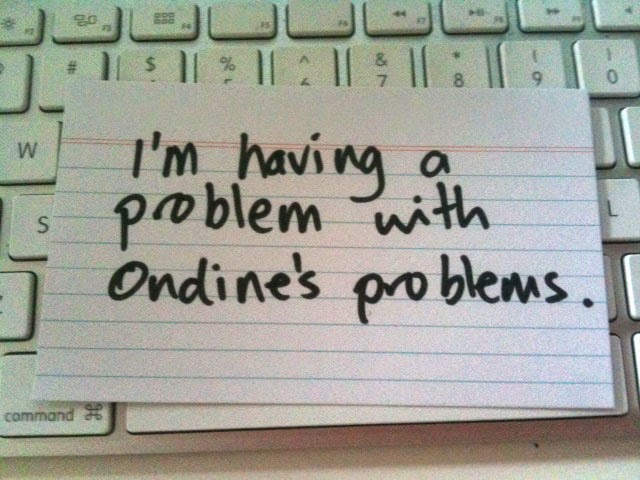 As you know, I love structure. As I was revising book 4, I knew something wasn't working, yet I couldn't really put my finger on it.
It was too loose and took far too long to get going. And then it hit me. I had created a whole new 'problem' for Ondine to solve, which was not really related to her existing issues. Nor was it a true complication of an earlier problem. It was a plot thread that would not fit in.
OK, it sort of was, but as that problem was something only mentioned in book 1, it was a problem most people wouldn't even remember.
Resurrecting that old problem into book 4, which in structure terms is the final act of the four novels, meant I was bringing in a whole new complication far, far too late in the piece.
If you think of a novel in the '3 Act' structure, the midpoint is about half way through the second act (hence its name) and from then on, there's no turning back. For example, in Gone With The Wind, there's a really good reason why they put the intermission after Scarlett comes back to Tara and declares she'll never go hungry again. This is the true mid point. Scarlett can't go 'back', the past is gone. She can only move forward, and if she has to lie or cheat or kill, yes, even if she has to kill, she'll never be hungry again.
I love that scene SO HARD!
All the problems Scarlett faces after this incredible mid point are not new. They are further complications that have continued to fester from the beginning.
I love it when my brain does me a solid.
Happy writing everyone.
Yes, I'm still revising Ondine 4. It will be ready when it's ready.
It was too loose and took far too long to get going. And then it hit me. I had created a whole new 'problem' for Ondine to solve, which was not really related to her existing issues. Nor was it a true complication of an earlier problem. It was a plot thread that would not fit in.
OK, it sort of was, but as that problem was something only mentioned in book 1, it was a problem most people wouldn't even remember.
Resurrecting that old problem into book 4, which in structure terms is the final act of the four novels, meant I was bringing in a whole new complication far, far too late in the piece.
If you think of a novel in the '3 Act' structure, the midpoint is about half way through the second act (hence its name) and from then on, there's no turning back. For example, in Gone With The Wind, there's a really good reason why they put the intermission after Scarlett comes back to Tara and declares she'll never go hungry again. This is the true mid point. Scarlett can't go 'back', the past is gone. She can only move forward, and if she has to lie or cheat or kill, yes, even if she has to kill, she'll never be hungry again.
I love that scene SO HARD!
All the problems Scarlett faces after this incredible mid point are not new. They are further complications that have continued to fester from the beginning.
I love it when my brain does me a solid.
Happy writing everyone.
Tuesday, 27 May 2014
Using All 11 Senses
Want to really get under the skin of your characters? Then do it. Get in their heads and get sensory.
You know the basic senses:
MORE senses:
You know the basic senses:
Sight - but some people are colour blind while others “see” the word Monday as
red. (This is called synaesthesia).
Sound - and the direction of where sounds are coming from.
Smell - evokes memories as well. This is the first sense that develops - even
before a baby is born.
Touch - a strong sense from birth. Babies use touch to see (putting things in
their mouths) because their eyes aren’t fully developed yet.
Taste - we have between 2,000 and 8,000 taste buds each. Taste is also
strongly linked with smell AND taste doesn’t work if our mouth is completely
dry. You need saliva to taste anything. This is probably why, when we smell
something delicious, our mouth starts watering.
Often my first drafts are a huge mess. The only senses I generally use are basic sights and sounds. Just to get the main story down. In the next drafts I go deeper, layering smells, tastes and touches on the pages too.
Often my first drafts are a huge mess. The only senses I generally use are basic sights and sounds. Just to get the main story down. In the next drafts I go deeper, layering smells, tastes and touches on the pages too.
Exercises:
1) Have some fun writing a story without using sight. What other senses do you use instead?
2) Write a story all about tasting new things. What do they taste like? Do they remind you of other foods? Do they bring back memories?
 |
| Picture Credit and loads more info here |
We have so much more than the
basic five senses. All of these are senses too:
Balance - ie, falling over or keeping your balance.
Stand up, put your arms out, then raise one knee. You will find your bady can still balance on one leg.
Now do it with your eyes closed. How hard is it to balance? That's because your sight also helps you keep your balance. The other part is the inner ear - there's a tiny amount of liquid in the inner ear that gives us balance - or vertigo if it’s damaged.
Temperature. We can touch something and feel how hard and soft it is, but we can
also feel the temperature around us all the time. Is it hot or cold in here?
Mum’s always telling you to put your jacket on but you don’t feel the cold???
Proprioception - this is a big fancy word to say we know where our body is in the space
we’re taking up. Without having to look, we know our arm is leaning on the
table, we know where our feet are. We can cross our feet without having to look
at them first to make sure they’re going the right way. Some people can type on
a keyboard without having to look where the letters are because they know where
their fingers are in the ‘space’ around them.
Close your eyes and touch your finger to the end of your nose. You don’t have to see it to do it. This is where your senses step in and help you.
Pain - we have pain receptors in our body that tell us when something is
wrong with our body. We fall off the monkeybars and our foot is killing us.
It’s our body's way of making us take the weight off and rest our foot until
it’s healed.
Time - you know how sometimes time flies or it drags? This is also a sense.
It’s our brains processing the passing of time.
Not strictly a sense,
but everyone feels various amounts of:
Emotions - Our brains process emotions and feelings. We’re happy when we see
friends and have a good time, we’re miserable when we’re hurt. We also have
mixed emotions when we remember events from the past, or anticipate what’s
coming up tomorrow.
For example, an
assignment is due tomorrow, you’re nervous about whether the teacher will give
you good marks. On Tuesday night you’re having a sleepover, so you’re excited
about staying up late and playing Plants vs Zombies all night.
By using more than our basic senses in a story, we create a real world for the character and the reader. Too many senses all at once can become confusing, but not enough can make the story feel underdeveloped.
It's up to you to find the balance.
Animals and plants with extra senses:
Echolocation - bats
and some other animals can sense where they are - even in flight - by detecting
the speed of soundwaves bouncing off cave walls.
Electroreception -
sharks and platypus can sense changes in the magnetic fields around them - or
even create magnetic fields.
Magnetoreception -
birds migrate using this - aligning themselves to the earth’s magnetic fields.
Wednesday, 26 February 2014
Discoverablility
 |
| Book the first. Amazing cover. |
You can:
Write a great book.
Have a sensational cover.
Have a big publisher making sure your book is
a) in the stores
b) going out to reviewers
c) entering awards
d) getting great reviews
e) winning awards
f) selling copies.
Yet even with all of these elements in your favour, your time as 'next big thing' becomes 'whatever happened to' in the snap of a pencil.
Most paper books published the traditional way spend a month on the shelves in the stores.
A month to get noticed.
 |
| Book the second. Stunning cover. |
Sometimes publishers do the 'double dipping'. They bring the first book out in expensive hardback, in the hope of selling a few thousand copies, mostly to libraries. Then a year later, they bring the same book out as a paperback. This reminds readers about the author, gives them another chance to sell and be in the stores. (My books were not brought out in hardback, by the way, so Ondine didn't get a second shot.)
Reviews, stores, covers, all for one month on the shelves, and if they don't sell, they are usually returned to the publisher and pulped.
Then, if you're lucky enough to have a two book deal, it all happens all over again with the second book. Except it doesn't. You're no longer a 'debut' author, so your book isn't promoted as a 'shiny new thing' and there may not even be advance copies sent out to reviewers . . .
 |
| Book the third. Brilliant cover. |
Which is why so many authors I know (myself included) are bringing out their new books independently and self-publishing. Our books might not be in the bricks & mortar stores, but they are available on line and once they're up, they're up there forever.
No more returns eating into their royalty statements, no more limited shelf life, more staying power.
Along with 20 million other titles out there.
New books are getting published every day but the old ones are not moving on. This is both a blessing and a curse. Readers can get their hands on 'old' books any time they like, but there are so many new books coming out it's hard to sort through it.
People also want to know if the book is going to be worth their money and their time. Under $5 is considered affordable in most budgets, but you're asking someone to commit a fair amount of time. Older books have already proved this, so there is something of a 'flight to safety' in our choice of reading material. Newer authors are an unknown quantity. As much as people love a little novelty, they also want to know what they're in for.
It's also incredibly difficult for newer books to stand out in a crowded marketplace. Again, they can have beautiful covers (like mine), glowing reviews (like mine) and win awards (oh yeah, like mine) but the author still has plenty of work to do getting the word out.
This is where self-publishing becomes really, really hard. I can see why some would give up after painfully low sales.
Most self-published authors don't have a paid publicist to do the promotions for them.
But they also don't have the one-month on the shelves window slamming shut on them either.
Self-published authors have to be organised. I advertised for a couple of months on a popular romance fiction website. I had some good click-throughs but ultimately, it didn't sell books. The exercise was about being seen and getting some interest. In the end I don't think it was the right website for my books. My books are young adult (see how young Ondine is on the covers?) and there is plenty of whacky magic and comedy. And footnotes. My books didn't fit the demographic of that website.
So I am doing more homework and looking to place adverts on websites that appeal to readers of my kind of book. In a way, I have to narrow it down in order to get the biggest amount of appeal.
I'll keep you updated on how it goes.
Thursday, 19 December 2013
Does Your Story Have a 'Death Star' Moment?
Because it totally needs it.
You know, way back in "A New Hope", that first film (which
was called Episode IV).
The bad guys show they mean business. They show us that the Death Star is operational. They show it blowing up a planet for goodness' sake!

 If, on the other hand, we'd never seen that example, the audience would be denied the fear and thrill of knowing, absolutely, how dangerous the Death Star is. We need to see how frightening something can be, otherwise it's all simply theoretical.
That's why the Daleks exterminate an extra, early in the piece. To SHOW us the danger The Doctor and his companions are in.
Yeah, those are pretty nerdy examples. OK, let's look at Samuel L Jackson. In his words (and I'm paraphrasing) he used to read scripts and see his character get killed off. Because his character was there to serve as a warning for others. He has died in 18 movies.
 As Jackson's star rose, he began to live to the end credits (way to go!). Then something weird happened. In films to come, his characters started dying again. (Like being eaten by a shark in Deep Blue Sea). He wondered why, and the director said "Because if your character can die, that means anyone can die."
And now of course I can't find the link. But hey, it's just an example, OK?
The reason I'm talking about this is because *drumroll* I DID NOT HAVE A DEATH STAR MOMENT IN ONDINE 4.
I know.
I am so disappointed in me.
I knew there was something 'not working' in the story, and it would come to me eventually and then I'd work it out.
Now I have. I need to bring in a metaphorical Death Star, show how it works, have the worst thing happen. THEN our plucky heroes can get to work restoring peace in the galaxy.
So when you're writing a story, have a big think: What's the worst thing could happen?
Make it happen.
Then make it all right again.
You know, way back in "A New Hope", that first film (which
was called Episode IV).
The bad guys show they mean business. They show us that the Death Star is operational. They show it blowing up a planet for goodness' sake!
If, on the other hand, we'd never seen that example, the audience would be denied the fear and thrill of knowing, absolutely, how dangerous the Death Star is. We need to see how frightening something can be, otherwise it's all simply theoretical.That's why the Daleks exterminate an extra, early in the piece. To SHOW us the danger The Doctor and his companions are in.
Yeah, those are pretty nerdy examples. OK, let's look at Samuel L Jackson. In his words (and I'm paraphrasing) he used to read scripts and see his character get killed off. Because his character was there to serve as a warning for others. He has died in 18 movies.
As Jackson's star rose, he began to live to the end credits (way to go!). Then something weird happened. In films to come, his characters started dying again. (Like being eaten by a shark in Deep Blue Sea). He wondered why, and the director said "Because if your character can die, that means anyone can die."And now of course I can't find the link. But hey, it's just an example, OK?
The reason I'm talking about this is because *drumroll* I DID NOT HAVE A DEATH STAR MOMENT IN ONDINE 4.
I know.
I am so disappointed in me.
I knew there was something 'not working' in the story, and it would come to me eventually and then I'd work it out.
Now I have. I need to bring in a metaphorical Death Star, show how it works, have the worst thing happen. THEN our plucky heroes can get to work restoring peace in the galaxy.
So when you're writing a story, have a big think: What's the worst thing could happen?
Make it happen.
Then make it all right again.
Thursday, 13 June 2013
How's the 1,000 Words a Day Working Out?
I'm as pleased as plütz that this new writing regime is actually working.
I'm now in the fourth week of 1KPD. I'm writing 1,000 words per day, Monday to Friday and taking weekends off.
I've reached my goal (or gone a little over, which is always a bonus) for every writing day. Some days the words are easier to come by and I'm writing as fast as I can to keep up with what's playing out in my head.
Then there are the rubbish writing days. Yesterday was awful - but I forced myself because nobody else will write this book for me. The words are probably terrible, but I can fix bad words.
It's Thursday now, and I'm not going to stop until I've added at least another 1,000 words to 'Ondine 4' file. Old Col in uncharacteristically snappish. This has Ondine very worried because although her great auntie is a lovely woman and delightfully mad, she's starting to become a big old meanie and that's not like her. This of course means that SOMETHING IS UP! (Should I let you in on a secret? I don't actually know what that something is, but I'm sure Col will tell me at some point).
Meanwhile, here's a progress report on the USA/Japan/Russia/China/Moldova ebook edition.
Nearly there!

I'm now in the fourth week of 1KPD. I'm writing 1,000 words per day, Monday to Friday and taking weekends off.
I've reached my goal (or gone a little over, which is always a bonus) for every writing day. Some days the words are easier to come by and I'm writing as fast as I can to keep up with what's playing out in my head.
Then there are the rubbish writing days. Yesterday was awful - but I forced myself because nobody else will write this book for me. The words are probably terrible, but I can fix bad words.
It's Thursday now, and I'm not going to stop until I've added at least another 1,000 words to 'Ondine 4' file. Old Col in uncharacteristically snappish. This has Ondine very worried because although her great auntie is a lovely woman and delightfully mad, she's starting to become a big old meanie and that's not like her. This of course means that SOMETHING IS UP! (Should I let you in on a secret? I don't actually know what that something is, but I'm sure Col will tell me at some point).
Meanwhile, here's a progress report on the USA/Japan/Russia/China/Moldova ebook edition.
Nearly there!

Monday, 20 May 2013
How to write a 50,000-word First Draft
It's scary how easy it is to lose time and *not* write.
My first drafts clock in somewhere around 50,000 words. They come with huge gaps and hardly any description. But it's a first draft, and as everyone knows, first drafts are crap.
So why do they take me so long?
Ten or so years ago, I wrote 50,000 words in two weeks. Two freaking weeks!
It was utter dross, but I wrote it.
Then, a few months later, I did it again!
It was more dross, but I was really enjoying myself. 25,000 words a week, or about 3,500 words a day.
It was awesome.
I've also never achieved this level of output since. But somewhere along the way, I *think* the writing improved, so there are payoffs to being slower.
Here's how to write 50,000 words.
By writing the words!
Writing 100 words a day, every day, will take 500 days (1 yr, 4.5 months) to get to 50,000 words.
Writing 250 words a day, every day, will take 200 days (nearly 7 months) to get to 50,000 words.
Writing 500 words a day, every day, will take 100 days, or about 3 months and a week-ish, to get to 50,000 words.
Writing 1,000 words a day, every day, will take 50 days, or less than 2 months, to get to 50,000 words.
Writing every day means writing on weekends as well. This isn't always practical or even possible.
Writing 1,000 words a day, 5 times a week, will take 10 weeks, (less than 3 months) to get to 50,000 words.
Obviously, if I write more words each day, I'll get there even faster. But I don't want to put too much pressure on myself by setting unreachable goals and failing to meet them (and subsequently feeling like a failure).
I'm going for the 1,000 words a day model, with weekends off.
Today I added 1,000 words to a mansucript that's now at 23,600 words. Which means I *should* finish this draft in the next five weeks, right?
Have I mentioned lately what a hypocrite I am? I'm GREAT at dishing out advice. Terrible at taking it. Even my own.
My first drafts clock in somewhere around 50,000 words. They come with huge gaps and hardly any description. But it's a first draft, and as everyone knows, first drafts are crap.
So why do they take me so long?
Ten or so years ago, I wrote 50,000 words in two weeks. Two freaking weeks!
It was utter dross, but I wrote it.
Then, a few months later, I did it again!
It was more dross, but I was really enjoying myself. 25,000 words a week, or about 3,500 words a day.
It was awesome.
I've also never achieved this level of output since. But somewhere along the way, I *think* the writing improved, so there are payoffs to being slower.
Here's how to write 50,000 words.
By writing the words!
Writing 100 words a day, every day, will take 500 days (1 yr, 4.5 months) to get to 50,000 words.
Writing 250 words a day, every day, will take 200 days (nearly 7 months) to get to 50,000 words.
Writing 500 words a day, every day, will take 100 days, or about 3 months and a week-ish, to get to 50,000 words.
Writing 1,000 words a day, every day, will take 50 days, or less than 2 months, to get to 50,000 words.
Writing every day means writing on weekends as well. This isn't always practical or even possible.
Writing 1,000 words a day, 5 times a week, will take 10 weeks, (less than 3 months) to get to 50,000 words.
Obviously, if I write more words each day, I'll get there even faster. But I don't want to put too much pressure on myself by setting unreachable goals and failing to meet them (and subsequently feeling like a failure).
I'm going for the 1,000 words a day model, with weekends off.
Today I added 1,000 words to a mansucript that's now at 23,600 words. Which means I *should* finish this draft in the next five weeks, right?
Have I mentioned lately what a hypocrite I am? I'm GREAT at dishing out advice. Terrible at taking it. Even my own.
Friday, 17 May 2013
How To Plan
Planning is something we do every day, sometimes deliberately, sometimes subconsciously.
The way plans really work is to write them down. Just as I wrote this talk down first. (And deleted the waffle. Oh the waffle!)
Setting Goals:
A mountain climber doesn’t wake up one morning and set out for Everest on a whim. In the same way, a writer can’t simply ‘decide’ they’re going to write a novel in one day.
The Novel is the Mountain:
We’re standing at the bottom of it, looking up. It’s insurmountable from here. Especially as we haven’t done the training and we don’t have the equipment. Just as Hillary couldn’t get up Everest without Sherpa Tenzing and a tank of oxygen, we can’t write a novel without the equivalent in chocolate and cheer squads to help us navigate the way.
The non-writer’s idea of Goal setting:
Step 1. Write a novel
Step 2. Get it published
Step 3. Profit
Which is a lot like the underpants stealing gnomes in South Park.
A mountain climber doesn’t wake up one morning and set out for Everest on a whim. In the same way, a writer can’t simply ‘decide’ they’re going to write a novel in one day.
The Novel is the Mountain:
We’re standing at the bottom of it, looking up. It’s insurmountable from here. Especially as we haven’t done the training and we don’t have the equipment. Just as Hillary couldn’t get up Everest without Sherpa Tenzing and a tank of oxygen, we can’t write a novel without the equivalent in chocolate and cheer squads to help us navigate the way.
The non-writer’s idea of Goal setting:
Step 1. Write a novel
Step 2. Get it published
Step 3. Profit
Which is a lot like the underpants stealing gnomes in South Park.
1. Collect Underpants.
2. ?
3. Profit!
Publishing is changing drastically. Advances are falling. I hear publishers in the UK are cancelling contracts. (I don’t have hard data, but I’ve heard it now from two personal sources so maybe there’s some truth in it?)
Back to setting goals:
As the mountaineer begins a rigorous training regimen over many months, so too must a writer. Writing every day flexes the creative muscles and gets them in top shape.
So here’s how writers really plan. We plan by setting goals for ourselves, then breaking things down into smaller and smaller achievable steps along the way. Measurable steps. Achievable steps.
1.Write down your goals
2. Create a PLAN
3. Break the plan down into achievable steps
4. Do the steps in order
5. Reward yourself each time you reach one of your steps.
6. Keep Going.
Publishing is changing drastically. Advances are falling. I hear publishers in the UK are cancelling contracts. (I don’t have hard data, but I’ve heard it now from two personal sources so maybe there’s some truth in it?)
Back to setting goals:
As the mountaineer begins a rigorous training regimen over many months, so too must a writer. Writing every day flexes the creative muscles and gets them in top shape.
So here’s how writers really plan. We plan by setting goals for ourselves, then breaking things down into smaller and smaller achievable steps along the way. Measurable steps. Achievable steps.
1.Write down your goals
2. Create a PLAN
3. Break the plan down into achievable steps
4. Do the steps in order
5. Reward yourself each time you reach one of your steps.
6. Keep Going.
HERE IS A BONUS. IF YOU GET THE HANG OF SETTING GOALS AND MAKING PLANS FOR WRITING NOVELS, YOU'LL FIND WAYS TO INCORPORATE THIS INTO YOUR CHARACTERS - WHO ALSO NEED GOALS AND NEED TO MAKE PLANS TO CARRY THE STORY FORWARD.
Stage One.
1. Have an idea.
2. Write it down.
3. Write every day.
4. Read books you enjoy.
5. Read books you don’t enjoy.
6. Write every day.
7. Read about structure.
8. Read about plotting.
9. Read about creating believable characters.
10. Write every day.
11. Write though the saggy middle.
12. Write every day.
13. Write the black moment where all seems lost, there is no way out and love is not enough.
14. Read more books that you love and hate.
15. Write to the very end.
You have completed a novel. Congratulations.
Stage One.
1. Have an idea.
2. Write it down.
3. Write every day.
4. Read books you enjoy.
5. Read books you don’t enjoy.
6. Write every day.
7. Read about structure.
8. Read about plotting.
9. Read about creating believable characters.
10. Write every day.
11. Write though the saggy middle.
12. Write every day.
13. Write the black moment where all seems lost, there is no way out and love is not enough.
14. Read more books that you love and hate.
15. Write to the very end.
You have completed a novel. Congratulations.
Now put it away and start again.
Have another idea.
Have another idea.
Write another novel. Repeat steps 1-15.
What’s not in the plan?
Blogs, websites, twitter, facebook and the rest of them.
Personally, I wouldn’t worry about blogging or building a twitter following at this point, because it will take time and energy away from finishing the novels.
Would you open a furniture store if you were still whittling? No.
Editing isn’t in the plan yet. Editing is the next stage.
1. Take the manuscript you haven’t looked at for three months
2. Read it without making any changes.
3. Read it out loud to get a sense of the flow and dialogue.
4. Have you made it to chapter 2 without cringing? Good for you.
5. Edit
6. Edit some more
7. Edit
8. Edit some more
9. Is it worth saving? Probably not. Set it aside and start on a new manuscript.
These multiple stages and myriad steps highlight how long it takes to write novels, and how much effort and work goes into them.
If you’re impatient or setting yourself impossible deadlines, your writing will suffer. Take time to make all the mistakes now, in private, instead of rushing to publication before you’re ready.
Stage three
PUBLICATION
1. Research.
2. Research.
3. More research.
4. Yet more research.
5. Even more research.
6. Figure out if you need an agent.
7. Find out if that agent is taking queries. If not, go back to step 1.
8. Find out if your chosen publisher will accept unsolicited manuscripts.
9. Craft a query letter or pitch for your chosen agent or publisher.
10. Throw it away, it will be terrible
11. Craft another query letter.
12. Get a friend to help you make that letter make sense.
13. Read, read and read more on how to write a proper query letter.
14. Follow the agent or publisher’s query guidelines exactly. If they don’t take romance, there’s no point in sending them your romance manuscript.
15. Steel yourself for rejections. They are a fact of life.
The ‘publication stage’ can take months or years. Use that time to read more books and write more novels.
If all these stages and steps look like far too much hard work, you’re right. It is hard work. If you don’t want to do the hard work, that’s OK. You can still write and gain enjoyment from writing. Nobody is going to stop you.
But if your ultimate goal is to be published in the traditional sense, by an advance-paying publisher, then you can’t skip any of the steps.
“A journey of a thousand miles begins with a single step.” Lao Tzu.
“The phoenix can fly only when its feathers are grown.” Monkey Magic.
What’s not in the plan?
Blogs, websites, twitter, facebook and the rest of them.
Personally, I wouldn’t worry about blogging or building a twitter following at this point, because it will take time and energy away from finishing the novels.
Would you open a furniture store if you were still whittling? No.
Editing isn’t in the plan yet. Editing is the next stage.
1. Take the manuscript you haven’t looked at for three months
2. Read it without making any changes.
3. Read it out loud to get a sense of the flow and dialogue.
4. Have you made it to chapter 2 without cringing? Good for you.
5. Edit
6. Edit some more
7. Edit
8. Edit some more
9. Is it worth saving? Probably not. Set it aside and start on a new manuscript.
These multiple stages and myriad steps highlight how long it takes to write novels, and how much effort and work goes into them.
If you’re impatient or setting yourself impossible deadlines, your writing will suffer. Take time to make all the mistakes now, in private, instead of rushing to publication before you’re ready.
Stage three
PUBLICATION
1. Research.
2. Research.
3. More research.
4. Yet more research.
5. Even more research.
6. Figure out if you need an agent.
7. Find out if that agent is taking queries. If not, go back to step 1.
8. Find out if your chosen publisher will accept unsolicited manuscripts.
9. Craft a query letter or pitch for your chosen agent or publisher.
10. Throw it away, it will be terrible
11. Craft another query letter.
12. Get a friend to help you make that letter make sense.
13. Read, read and read more on how to write a proper query letter.
14. Follow the agent or publisher’s query guidelines exactly. If they don’t take romance, there’s no point in sending them your romance manuscript.
15. Steel yourself for rejections. They are a fact of life.
The ‘publication stage’ can take months or years. Use that time to read more books and write more novels.
If all these stages and steps look like far too much hard work, you’re right. It is hard work. If you don’t want to do the hard work, that’s OK. You can still write and gain enjoyment from writing. Nobody is going to stop you.
But if your ultimate goal is to be published in the traditional sense, by an advance-paying publisher, then you can’t skip any of the steps.
“A journey of a thousand miles begins with a single step.” Lao Tzu.
“The phoenix can fly only when its feathers are grown.” Monkey Magic.
Thursday, 18 April 2013
I missed a turning point!
I've been reading over the first two Ondine novels and noticed in Ondine: The Autumn Palace, that I'd skipped over a pretty huge turning point - where Ondine takes the easy way out and decides to cheat on her tests - with Hamish's help.
Hamish wants to help her any way he can, so he's not doing it to be horrible or anything.
Ondine wants to stay with Hamish, so she's only resorting to cheating in order to maintain her grades and not be kicked out of school, and therefore the palace.
And yet in the paperback version, I completely fluffed it! I can't believe I skated over such a big turning point with exposition, told in past tense.
Here's how it was: (I've emphasised the problem in bold)
And here's how it will be in the USA ebook version. It shows Ondine making the choice between sucky and suckier (As Debra Dixon would say). The important thing is, it's happening on the page.
Which goes to show that I'm my own worst student. I hate it when important moments happen off the page - and I've gone and done it myself. I'm a hypocrite. Then again, I'm only human.
Hamish wants to help her any way he can, so he's not doing it to be horrible or anything.
Ondine wants to stay with Hamish, so she's only resorting to cheating in order to maintain her grades and not be kicked out of school, and therefore the palace.
And yet in the paperback version, I completely fluffed it! I can't believe I skated over such a big turning point with exposition, told in past tense.
Here's how it was: (I've emphasised the problem in bold)
There just weren’t enough hours in the day to study properly, so although she did her best, it wasn’t good enough.
Which meant she caved in and accepted Shambles’s stolen notes containing answers to her exams.
On this particular morning, classes had finished, but Ms Kyryl asked Ondine to go into her office. Ondine wasn’t thinking particularly psychic thoughts, but she knew it couldn’t be a good thing to have to stay behind. When she yawned, it only made things worse.
“Ondine, please sit.”
There just weren’t enough hours in the day to study properly, so although she did her best, it wasn’t good enough.
On one cold and dark night, after everyone had gone to bed, Ondine woke to find herself asleep on her desk, a trickle of dribble blurring her notes.
“Psst, lass, there’s another test in the morning.”
Groggy, she rubbed her eyes to find Shambles under her desk. She was so tired, she didn’t even have the energy to wish he was his wonderful self instead of the little animal. “There’s a test every morning.”
“I have the answers for ye, just in case ye need them, like.”
No energy to fight, Ondine took the folded sheet from Shambles and staggered into bed, fully clothed.
The next morning, as classes finished and they broke for lunch, Ms Kyryl asked Ondine to go into her office. Ondine wasn’t thinking particularly psychic thoughts, but she knew it couldn’t be a good thing to have to stay behind. When she yawned, it only made things worse.
“Ondine, please sit.”
Which goes to show that I'm my own worst student. I hate it when important moments happen off the page - and I've gone and done it myself. I'm a hypocrite. Then again, I'm only human.
Friday, 22 March 2013
Keeping Time
You know that horrible, rage-filled emotion of having wasted your time? Your precious, scarce, more valuable than gold-pressed-latinum time?
I was tweeting with a friend who'd recently seen a movie which filled her with screaming resentment. She was stuck there watching, and all she could think was, "This is a massive waste of my time. I want to get out of here. Now!"
I've had a morning like that. I sat at school assembly which went on and on and ON. An hour. Yes, assembly is important, but oh please kill me now. An hour!!!
After which, I had volunteered to do a cooking demonstration, so I had to sit through assembly. But then, because the assembly went so long, people walked out and nobody came to the cooking demonstration!
Cue white-hot-rage-resentment episode.
If we'd been told assembly would take an hour, but there would be yummy biscuits (ie mine) afterwards, it could have been OK. But I felt trapped by the uncertainty of not knowing what was going on or how long it would take. That clawing "I've got to get out of here" feeling took over.
I would have been desperate to get out of there and get on with the day too.
So, after all that resentment rage, I came home, cried, cancelled the physio appointment so I could claw back some time and got on with writing.
Which led me to this epiphany. I've read books where that "I've got to get out of here" feeling came over me. But with books, all I needed to do was close it and move on to the next book on the TBR pile. I don't get "trapped" with it.
The thing is, you never want your reader to feel like they're trapped in your book and they want to get out. Because they will get out, and they might never come back.
Here again, is where structure will help you. (You knew we'd get back to structure, right?)
State the plan.
Like a James Bond movie. Here's the villain, here's what he's up to, you have to stop him. And blow EVERYTHING up at the end like a good Bond.
Show where it's going.
Have characters openly acknowledge what they want and how they think they're going to get it.
Give it a time frame.
This adds urgency to the issue and keeps the pace tight. "If we don't solve this crime by midnight, the perp goes free." or "If Hamish doesn't get his work papers before the immigration inspectors come back next week, he'll be deported. To Scotland!"
Give it all you've got.
Above all, reward people for giving you their precious time. Write well, then write weller.
I was tweeting with a friend who'd recently seen a movie which filled her with screaming resentment. She was stuck there watching, and all she could think was, "This is a massive waste of my time. I want to get out of here. Now!"
 |
| Time. More please. |
After which, I had volunteered to do a cooking demonstration, so I had to sit through assembly. But then, because the assembly went so long, people walked out and nobody came to the cooking demonstration!
Cue white-hot-rage-resentment episode.
If we'd been told assembly would take an hour, but there would be yummy biscuits (ie mine) afterwards, it could have been OK. But I felt trapped by the uncertainty of not knowing what was going on or how long it would take. That clawing "I've got to get out of here" feeling took over.
I would have been desperate to get out of there and get on with the day too.
So, after all that resentment rage, I came home, cried, cancelled the physio appointment so I could claw back some time and got on with writing.
Which led me to this epiphany. I've read books where that "I've got to get out of here" feeling came over me. But with books, all I needed to do was close it and move on to the next book on the TBR pile. I don't get "trapped" with it.
The thing is, you never want your reader to feel like they're trapped in your book and they want to get out. Because they will get out, and they might never come back.
Here again, is where structure will help you. (You knew we'd get back to structure, right?)
State the plan.
Like a James Bond movie. Here's the villain, here's what he's up to, you have to stop him. And blow EVERYTHING up at the end like a good Bond.
Show where it's going.
Have characters openly acknowledge what they want and how they think they're going to get it.
Give it a time frame.
This adds urgency to the issue and keeps the pace tight. "If we don't solve this crime by midnight, the perp goes free." or "If Hamish doesn't get his work papers before the immigration inspectors come back next week, he'll be deported. To Scotland!"
Give it all you've got.
Above all, reward people for giving you their precious time. Write well, then write weller.
Tuesday, 19 February 2013
What's at stake?
 |
| Taken from this website. |
If you're a writer, you've probably heard the advice, which many people shoot home to Donald Maass from his seminal book Writing The Breakout Novel.
"Raise the stakes", and "what's at stake?" and "Who cares"? etc.
Somewhere in your story is an underlying urgency and strong need to make something happen.
It pushes the story along. It drives the characters to do what they do.
Every agent, editor and publisher is looking for this. They need to see in your writing an edge that puts your manuscript ahead of the others.
BUT
Lately I've been wondering. And thinking. Two of the most recent world phenomenons have been, to me, pretty darn dull. (Obviously, I'm talking about 50 Shades and Twilight). I've read the first Twilight and honestly felt like there was nothing at stake, apart from one girl's desperate need to become subservient to another man. If Edward didn't return her love, she'd die. Not just figuratively, but emotionally and most likely physically (because she'd stop eating and become even more mopey).
I look forward to your angry emails.
The other book I deliberately haven't read because so many of my friends have told them how much it annoyed them. But from what I understand, 50 Shades follows Twilight pretty closely, and again, there's not much at stake.
What's up, universe? I'm busting my chops to raise the stakes, make sure the protagonist has a driving goal, show what will happen if she doesn't achieve her aims and make sparkling characters we can cheer on. Meanwhile, two of the biggest phenomenons don't have this.
Is it a case that agents, editors and publishers are in fact burnt out?
Do they read sooooo much, that they've become jaded? Have they forgotten that most readers might only read one or two books a month, and they want something comforting instead of confronting?
I don't know.
Sorry if you got this far and wanted answers.
No, seriously, I'm sorry.
I really am wondering whether publishers are reading so much that they need more and more at stake to keep them interested, to keep them excited. A little like the way adrenalin junkies need to take bigger risks to get the same high.
Whereas the average reader doesn't need to be blown away on the first page and sucked in so they simply cannot put the book down. Maybe most readers prefer something they can ease into and wallow in, something that wraps them in a warm blanket of love and nostalgia?
All I know is, I keep trying to write the next big thing. High concept, loads at stake, heaps of conflict... and I'm getting the most beautiful rejections that it's not what publishers are looking for at the moment.
They all say they love my characters, which makes me smile, because I love them too.
And then I sit back and take stock. After a few days I realise I can only write the sort of novels I write, and hope like hell there's an audience for them. I would really, really love a huge audience for them.
Maybe I'm so busy trying to please publishers I've forgotten that I should first and foremost be pleasing myself?
If I don't, I may go insane. That's pretty high stakes, don't you think?
Tuesday, 5 February 2013
Paperwork Update
If writing novels is 10% inspiration and 90% perspiration, then selling them is 10% marketing and 90% utter confusion.
Call me old fashioned, but I'm used to doing things in a set order.
If I want to sell a product, I figure I should do it thusly:
1. Make Product
2. Get Taxes/Paperwork In Order so it's all official
3. Sell Product
Not so in the USA. In the USA, my experience is I need to swap 3 & 2 around.
The lovely tax expert I've been dealing with in Canada (which is a tautology because all Canadians are lovely. You're welcome,) advised me that until I have an active account with Amazon (ie, selling my ebooks to readers in the US) the IRS will reject my ITIN application.
 This kind of logic makes me feel like I have to sell the books first, then apply to the IRS for the ITIN, which means the company paying me money (in this case, Amazon) can pay me the full amount without having to withhold tax.
Oh yes, and the IRS can take between 6 - 8 weeks to process the application. Then they may reject it. I've heard from writer friends that they can and do reject applications, sometimes without giving any reason.
I need to eat another curry pie to soothe my nerves.
Call me old fashioned, but I'm used to doing things in a set order.
If I want to sell a product, I figure I should do it thusly:
1. Make Product
2. Get Taxes/Paperwork In Order so it's all official
3. Sell Product
Not so in the USA. In the USA, my experience is I need to swap 3 & 2 around.
The lovely tax expert I've been dealing with in Canada (which is a tautology because all Canadians are lovely. You're welcome,) advised me that until I have an active account with Amazon (ie, selling my ebooks to readers in the US) the IRS will reject my ITIN application.

Oh yes, and the IRS can take between 6 - 8 weeks to process the application. Then they may reject it. I've heard from writer friends that they can and do reject applications, sometimes without giving any reason.
I need to eat another curry pie to soothe my nerves.
Saturday, 2 February 2013
Turning Points
I adore this scene. Scarlett begging for money, trying to disguise how she so desperately needs it.
She lies, she tries telling a bit of truth, then the whole truth, then she offers to become his mistress (it's not actually said here, merely implied) . . . and all for nothing.
I used it to illustrate the Staircase of Turning Points. I'll be running a similar breakout session, called Navigating The Markers, at the RWA Conference at Fremantle in August.
I'm writing a scene where one of the characters has to eat humble pie and ask relatives for money. It's uncomfortable to write, because I know it's going to end badly.
I'm using the essence of great turning points (like in the scene above) to keep the scene moving forward.
Turning points are absolutely marvellous, and are used to best effect when both characters bring their (opposing) agendas to a scene, and both want to get their own way. It often ends in tears, just like Scarlett's.
Just as the scene cuts out, Rhett says, "Cheer up, you can come to my hanging and I'll remember you in my will."
Scarlett says, "I'll come to your hanging. The only thing I'm afraid of is they won't hang you in time to pay the taxes on Tara."
Thursday, 31 January 2013
I Will (Survive) Still Need an ITIN
An ITIN is an Individual Taxation Identification Number that you get from the IRS, which stands for Inland Revenue Service. That's the USA's tax department.
 If you earn money in the USA but are a non-resident (ie, you live in 'The rest of the world' and you don't have a social security number) you will most likely need an ITIN. I will need one.
Here's a page about ITINs from the IRS with frequently asked questions. Make yourself a cuppa and read it.
OK, two cuppas. Here's the page of updated 2013 FAQs.
And a Tim Tam.
If you are planning on earning income from the US, (ie, selling ebooks on amazon, perchance) you don't want the hassle of the IRS withholding money . . . or auditing you.
Reading through the FAQs, I discover I am a 'non-resident alien'. Oh the LOLZ!
Off to make another cuppa.
Monday, 28 January 2013
Missing Pieces
Latest epiphany about structure: You don't need all the pieces all the time.
Here I was thinking "There are 12 stages of the Hero's Journey and I only have 8 so far for this manuscript."
I'm also reading The Virgin's Promise by Kim Hudson, which has 13 stages. (It's an amazing book, I'll do a post on it)
In Hudson's analysis of several movies, she notes that one of the movies has 12 of the 13 stages of The Virgin's Journey. It's not that the movie fails because the scene is missing, it still works fine . . .
Blammo! My brain tells me it's OK to have missing stages and scenes. Because they will either come later, or the story might work fine without them. (obviously not if it's missing too many. Like a satisfying showdown at the end.) The very worst thing I can do is try to create all the scenes right now, and force the scenes to happen.
A forced scene that comes to mind is from the movie National Treasure, where Nic Cage, Jon Voight and Diane Kruger are underground in tunnels . . . and suddenly Nic grabs Diane and kisses her, for no reason, then simply moves on.
I can't help wondering if test screening viewers wrote "it would be nice if there was a kiss"and the studios did a quick re-shoot. From memory, Jon Voight is not in frame when the kiss happens.
My point being, forcing a scene in there to fit the structure is worse than not having the scene in there at all.
Which is another way for me to justify not having the entire plot, er, plotted out, before I start writing.
Here I was thinking "There are 12 stages of the Hero's Journey and I only have 8 so far for this manuscript."
I'm also reading The Virgin's Promise by Kim Hudson, which has 13 stages. (It's an amazing book, I'll do a post on it)
In Hudson's analysis of several movies, she notes that one of the movies has 12 of the 13 stages of The Virgin's Journey. It's not that the movie fails because the scene is missing, it still works fine . . .
Blammo! My brain tells me it's OK to have missing stages and scenes. Because they will either come later, or the story might work fine without them. (obviously not if it's missing too many. Like a satisfying showdown at the end.) The very worst thing I can do is try to create all the scenes right now, and force the scenes to happen.
 |
| Not that I can find the actual picture of the kiss. Come on google, do a gal a favour. oh yeah, © Disney/Buena Vista |
I can't help wondering if test screening viewers wrote "it would be nice if there was a kiss"and the studios did a quick re-shoot. From memory, Jon Voight is not in frame when the kiss happens.
My point being, forcing a scene in there to fit the structure is worse than not having the scene in there at all.
Which is another way for me to justify not having the entire plot, er, plotted out, before I start writing.
Subscribe to:
Posts (Atom)